We use Polaris on Polaris.
This is the honest log of what that looks like: what the AI engines say about us, what gaps we found, what we decided to build, what got published, and what is — and isn't — moving yet.
The site launched in April 2026. We are not going to pretend that authority accumulates overnight. This page shows the real workflow — including the early stage where indexing is pending and AI citations are still zero.
The loop
Five steps. Run every week.
Monitor
Run target queries across ChatGPT, Claude, Gemini, and Google AI Overviews. Capture what the engines say.
Diagnose
Compare engine outputs to reality. Find citation gaps, sentiment gaps, and missing entity signals.
Decide
Prioritize the gaps that matter. Plan the specific assets that would close each one.
Build
Generate the assets — pages, posts, structured data, off-site content — and get them live.
Measure
Watch for indexing, citation changes, and organic signals. Feed results into the next loop.
Want to see how this loop is structured? Read how Polaris works →
The log
Weekly entries, newest first.
April 24 – May 7, 2026 — First citations, first features
What Polaris Found
- —ChatGPT Reasoning now cites the About page when users ask “what is Polaris GEO and what does it do?” — 8 citations with a 72.73% citation rate. The E-E-A-T rework (founder bio, Person schema, proof links) is the most likely driver.
- —The Why Brands Disappear in AI Search blog picked up 2 citations on a compare query — the first time a Polaris-authored content asset was cited by an AI engine.
- —Overall visibility is 0.3%, up from zero. Category leaders have 10–20x the visibility — expected for a new domain still building off-site authority.
What Was Decided
- →Build toward an agent-first workflow — let users plan and execute content strategies conversationally instead of only through the wizard.
- →Connect Google Search Console so managed content shows real organic performance alongside AI visibility — indexing status, impressions, clicks, and position.
- →Add image generation so the full blog workflow — write, illustrate, publish — stays inside Polaris without needing external design tools.
What Was Built
- ✓Google Search Console integration — full OAuth flow, URL Inspection, and 28-day Search Analytics. Managed content now shows index status, impressions, clicks, and average position directly in the My Content table.
- ✓Agent workspace and strategy planning — a dedicated conversational workspace where users can ask about program performance, plan strategies, and launch content directly through the agent.
- ✓AI image generation — cover images and inline blog illustrations via gpt-image-2, with drag-and-drop insertion and reference-aware style matching across posts.
- ✓About page E-E-A-T overhaul — founder bio, Person schema, proof links to Journey/Learn/Blog/Features. This likely drove the citation pickup on brand queries.
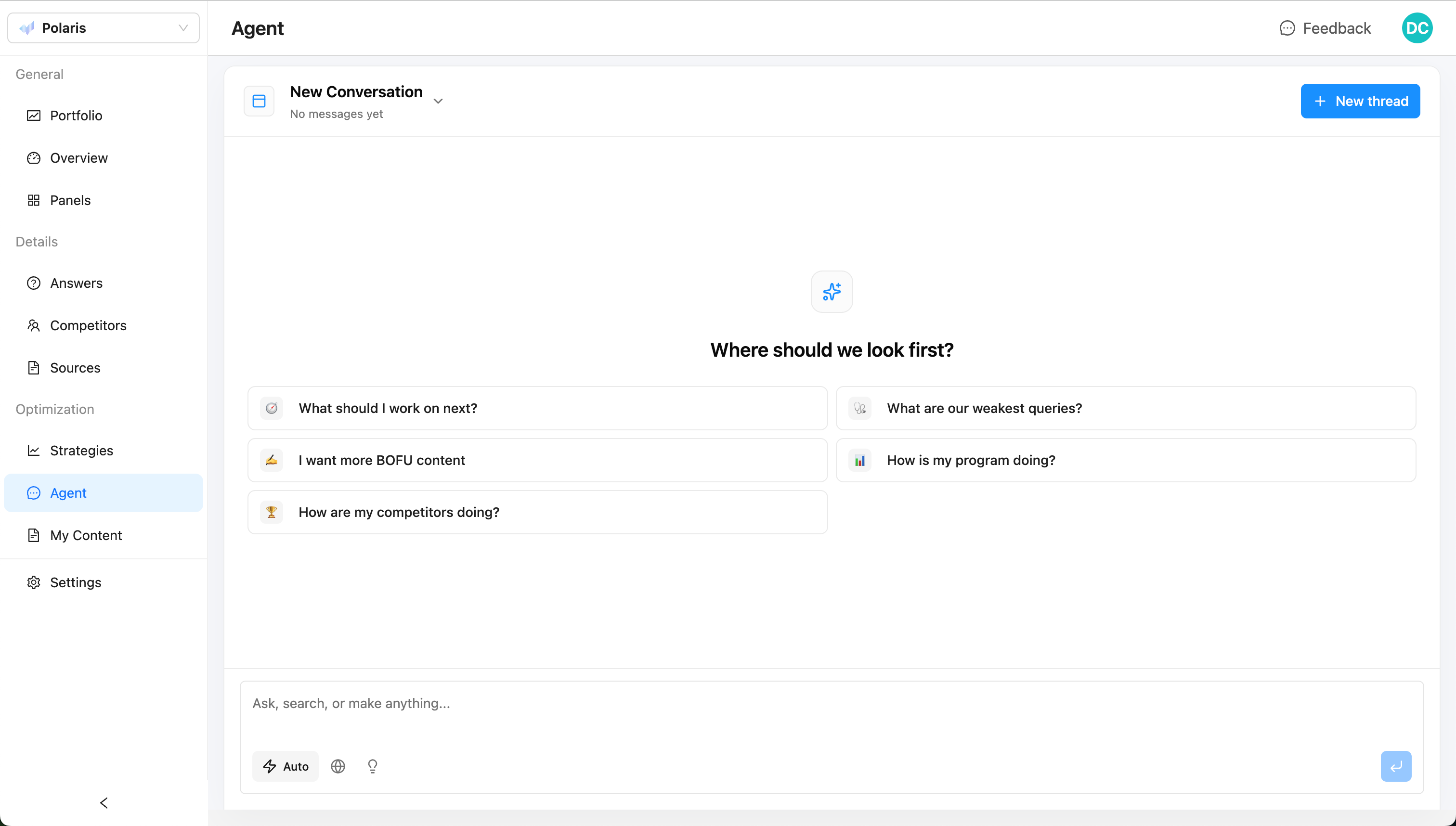
Agent workspace — conversational strategy planning with starter prompts.
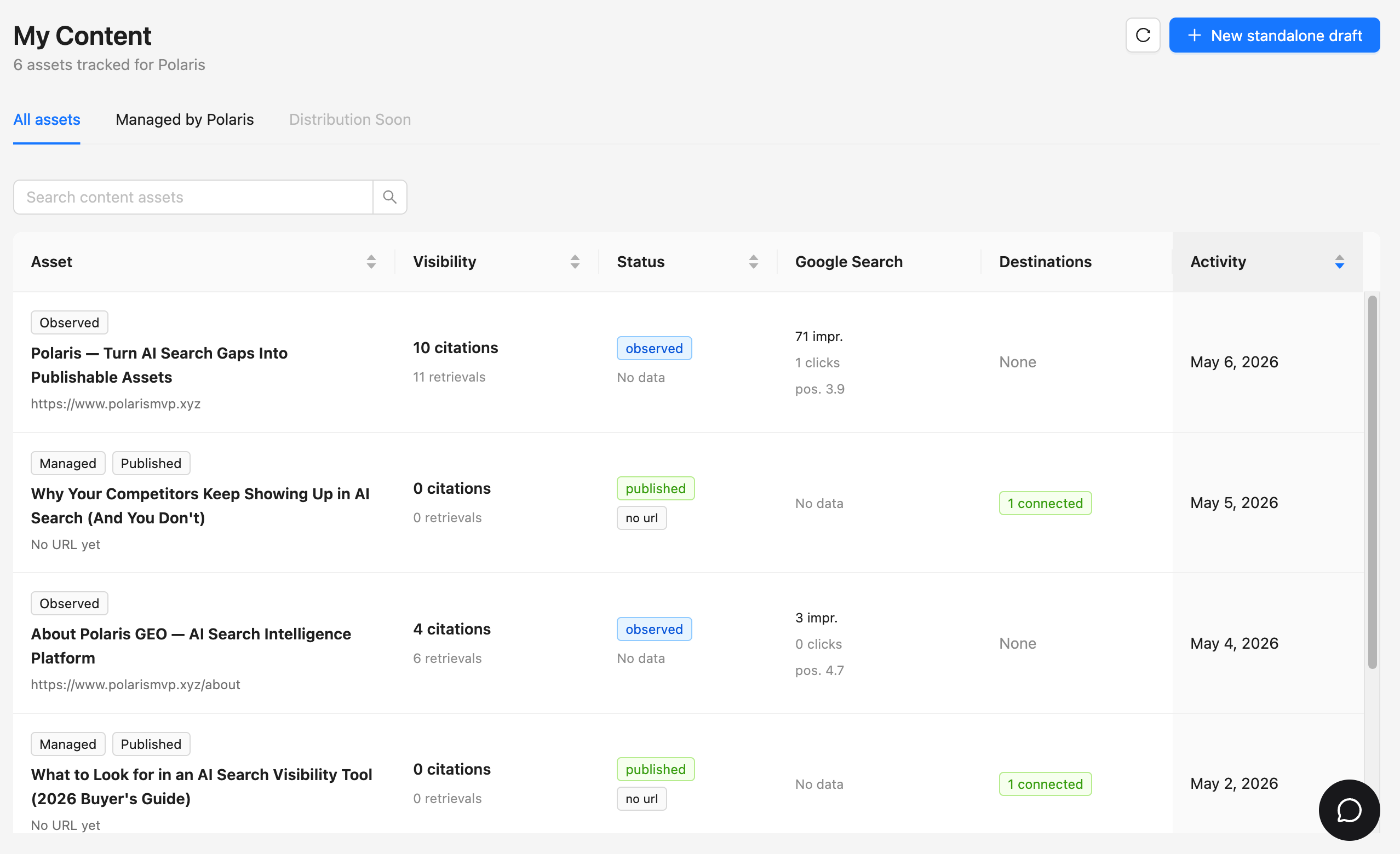
My Content with Google Search Console — index status, impressions, clicks, and position.
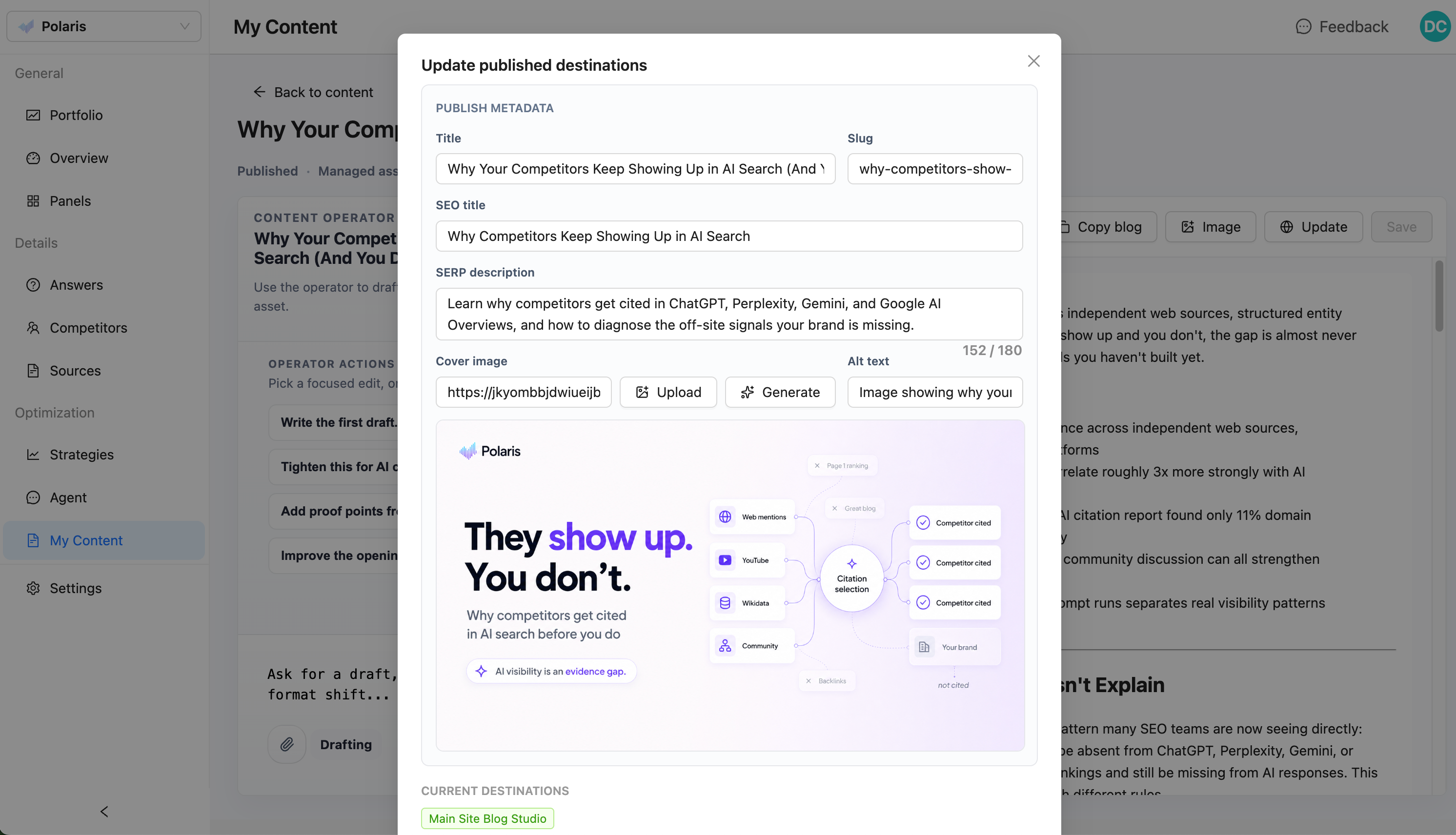
One-click cover image generation in the publish modal.
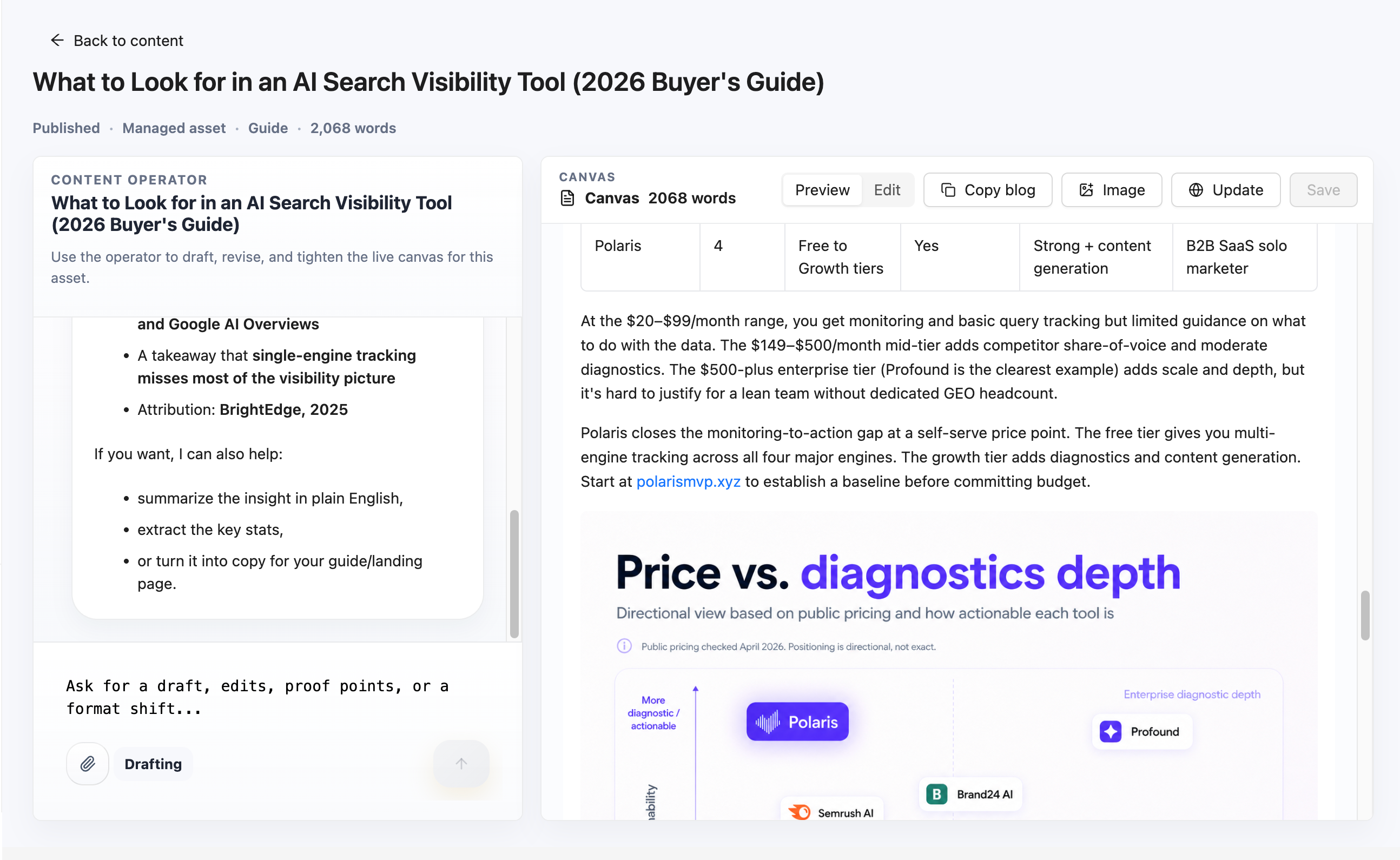
Inline image generation and drag-and-drop in the blog editor.
Where Things Stand
AI citations for Polaris
Up from 0 at Week 1. 8 on the About page, 2 on the Why Brands Disappear blog.
Overall visibility
Up from 0. Category leaders are at 10–20%. Expected gap for a new domain.
Citing engine
No citations yet from Claude, Gemini, or Google AI Overviews.
Cited pages
About page (brand queries) and one blog post (compare queries).
Features shipped
GSC integration, Agent workspace + strategy planning, AI image generation.
What's Next
- —Expand query coverage beyond brand queries — the discover-level citations on the About page show the trust signals are landing, now target broader category terms.
- —Publish additional blog posts to deepen topical authority and create more citation surface area for AI engines.
- —Watch for citation pickup on the GEO cornerstone pages and remaining blog spokes — these are indexed but not yet cited.
- —Continue building off-site mentions and directory listings to strengthen citation authority across all engines.
April 23, 2026 — The first loop
What Polaris Found
- —No brand citations in ChatGPT, Claude, Gemini, or Google AI Overviews when querying “AI search visibility platform” and related category terms. Polaris did not appear in any engine answer.
- —3 off-site brand mentions found across the web (LinkedIn company page, two minor directories). Insufficient for citation authority — most cited brands have hundreds.
- —Homepage was anchored on “AI search operator” — distinctive positioning, but not a searchable category phrase that matches how buyers discover tools.
- —No education pages existed for target category queries: “what is GEO”, “AI search visibility”, or “why isn't my brand showing up in ChatGPT”. These are high-volume informational queries with no Polaris content to match.
What Was Decided
- →Build a GEO education cluster to capture category-entry queries — the pages that rank for “what is generative engine optimization” and related searches, before buyers reach the product page.
- →Reposition the homepage around “AI search visibility” as the primary category anchor. Keep the “publishable assets” angle in the hero, but attach it to the searchable category term.
- →Publish 3 blog spokes to begin building topical authority: competitor gaps in AI search, how AI decides who to cite, and a buyer's guide to AI visibility tools.
What Was Built
- ✓/learn/geo hub — the GEO category entry point, with links to all 5 cornerstone pages and the 3 blog spokes.
- ✓5 cornerstone pages: What is GEO, GEO vs SEO, How AI search works, Why you're not cited, 2026 GEO checklist.
- ✓3 blog posts drafted and published via Polaris's Sanity CMS integration — written, reviewed, and pushed live without leaving the platform.
- ✓Homepage repositioned: new title tag, hero eyebrow updated to “AI search visibility”, intro copy sharpened, FAQ rebuilt around real buyer objections, placeholder logo bar replaced with actual AI engine coverage strip.
- ✓Schema markup added or updated across all new pages: BreadcrumbList, Article, CollectionPage, FAQPage, SoftwareApplication.
What Got Published — Indexing Status
Where Things Stand
AI citations for Polaris brand queries
Expected: weeks to months on a new domain with minimal off-site authority
Organic impressions from GEO pages
Pages are not yet indexed — this is normal at week 1
Off-site brand mentions indexed
Target: 50+ for meaningful citation authority. Current sources: LinkedIn + 2 directories.
Pages published to live site
Homepage, /learn/geo hub, 5 cornerstones, 3 blog posts, /journey
Blog posts published via Polaris → Sanity
Drafted and pushed live using the platform's CMS integration
What's Next (Week 2)
- —Run the weekly monitoring loop: check for indexing progress across all submitted pages and look for any new AI engine references.
- —Off-site mention strategy: submit to AI/SaaS tool directories, product listing sites, and relevant communities to start building citation authority.
- —2–3 additional blog posts to deepen topical authority in the GEO cluster and create more internal linking surface.
- —Check Google Search Console for first organic impressions on the education pages — even before rankings, impressions confirm the pages are indexed and surfacing for queries.
Honest context
What “early proof” actually looks like
We are not going to claim AI citation wins at week one. The site is new, domain authority accumulates slowly, and AI engines update their parametric knowledge on a crawl schedule that takes weeks to months on a new domain. That is just how this works.
What we can show right now is workflow proof — that Polaris ran the full loop on a real visibility gap and produced a real plan. And artifact proof — the pages, posts, and schema that came out of that plan, live on the site.
Performance proof — AI citations, organic traffic, and citation frequency — will appear on this page as it accumulates. We will update the log every week with real numbers, whether they are moving or not.
Workflow proof
The full Monitor → Diagnose → Decide → Build → Measure loop, running on Polaris itself. Every week.
Artifact proof
Pages, posts, and schema updates generated by Polaris and published to the live site this week.
Performance proof
10 AI citations across 2 pages, 0.3% visibility. ChatGPT Reasoning is citing the About page and one blog post.
Assets from these loops
GEO Learning Hub
The education cluster built in Week 1 — 5 cornerstone pages on AI search and generative engine optimization.
Why Your Brand Isn't Being Cited in AI Search
Cornerstone page on the 5 signal gaps that cause brands to be invisible in AI answers despite strong Google rankings.
Why Brands Disappear in AI Search Even When They Rank on Google
First Polaris blog to earn an AI citation — cited by ChatGPT Reasoning on a competitor compare query.
Why Your Competitors Show Up in AI Search (And You Don't)
Blog post from Week 1 — the off-site signal gaps most B2B brands miss.
How AI Search Engines Decide Which Brands to Cite
Blog post from Week 1 — parametric knowledge, RAG, and the citation selection layer explained.
How Polaris works
The full feature set: multi-engine monitoring, gap diagnosis, content generation, and CMS publishing.
Run this loop on your brand.
See exactly where you appear — and don't appear — in ChatGPT, Claude, Gemini, and Google AI Overviews. Free to start.